

Key Takeaway:
Phosphorus directly affects the performance of your crops—from early root development and energy use to maturity and grain fill. Managing it well can mean the difference between average and exceptional ROI. Understanding how phosphorus works allows growers to boost yield, quality, and sustainability.
Phosphorus is one of the three core nutrients growers depend on for crop success—yet it’s often misapplied or misunderstood. Add to that the fact that phosphorus fertilizer prices have spiked significantly in recent seasons, and growers face a costly risk: applying a nutrient that doesn’t always translate into plant uptake. In today’s margin-sensitive environment, inefficient phosphorus use isn’t just a waste—it’s a liability.
This guide breaks down phosphorus’s role in growth from an agronomic perspective, highlighting its biochemical function, soil behavior, and practical management tips (including how stabilization technologies like Phree-uP® can improve performance).
Why Phosphorus Is Important in Plant Growth
One of the first questions growers ask is Why use phosphorus for plants? The answer lies in phosphorus’s foundational role in plant development. From the earliest stages of root growth to flowering and grain fill, phosphorus is essential.
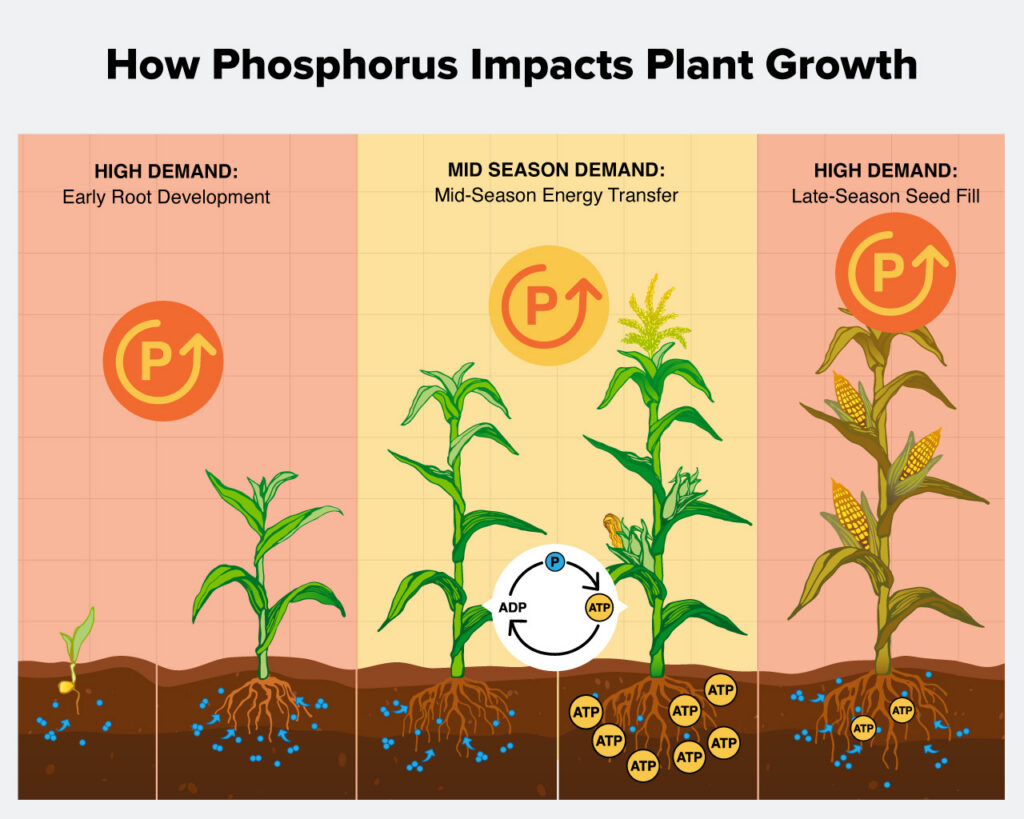
Phosphorus plays a crucial role in root initiation and proliferation, enabling plants to establish a stronger underground network. Without adequate phosphorus, root systems remain shallow, limiting water intake and nutrients. Once the plant reaches reproductive stages, phosphorus supports the formation of flowers, seed development, and the transfer of energy. In fact, adequate phosphorus often correlates with faster maturity and higher yield potential.
One useful framework for thinking about phosphorus efficiency is the “3 A’s”: Availability, Acquisition, and Assimilation. Phosphorus must first be available in the soil in plant-usable forms, then be acquired by the root system through uptake mechanisms, and finally be assimilated into plant biochemistry for processes such as energy transfer and reproduction. Optimizing all three phases ensures that applied phosphorus delivers real return.
To learn more about how phosphorus fits among other essential nutrients, check out our guide on Essential Plant Nutrients for a complete breakdown.
How Phosphorus Functions in Plant Biochemistry
Plants aren’t just passive sponges—they rely on phosphorus at the molecular scale. Below are three critical roles phosphorus plays inside the plant.
Phosphorus in DNA and RNA
Phosphorus sits at the backbone of nucleic acids. In DNA and RNA, phosphate groups link sugar molecules to form the structural framework of genetic material. Without phosphorus, plants can’t replicate cells or pass along genetic instructions effectively.
Phosphorus and ATP (Adenosine Triphosphate)
If chemistry had a currency, it would be ATP—and phosphorus is baked into every transaction. ATP is the energy “coin” that cells spend to power processes like nutrient transport, enzyme activation, and muscle-like movements within the plant. The “P” in ATP (for phosphate) is essential—without it, energy transfer grinds to a halt.
Phosphorus in Photosynthesis
Phosphorus also plays a crucial role behind the scenes during photosynthesis. It helps regenerate the molecules (like ADP to ATP) that enable conversion of light energy into chemical energy (sugars). Phosphorus ensures light energy gets converted into sugars the plant can use, supporting growth from emergence to fill.
That’s why phosphorus is non-negotiable—especially during early growth and reproduction. But for growers, the challenge is getting that phosphorus from the soil into these molecular roles—because when phosphorus is limited at the cellular level, it shows up in the field as slower canopy development, weaker root systems, delayed crop maturity, and reduced yield potential.
Phosphorus in Soil: Availability and Challenges
Just because you put phosphorus in the soil doesn’t mean plants can access it. The difference between phosphorus applied and phosphorus available is where much of the agronomic challenge lies. One of the core NUE challenges is reducing the gap between what you apply and what the crop actually uses. The Balanced Acre model tackles this by focusing on nutrient positioning, timing, and protection—keeping more phosphorus plant-available throughout the season.
How Soil pH Affects Phosphorus Availability
Soil pH is a gatekeeper. In very acidic soils (low pH), phosphorus tends to bind with aluminum and iron, forming compounds plants can’t use. In alkaline soils (high pH), phosphorus complexes with calcium, also reducing availability. The sweet spot is often between pH 6.0 and 7.5, where phosphorus remains most soluble.
For example, in acid soils (pH < 5), aluminum phosphate precipitates dominate, locking phosphorus out of reach. Conversely, in very alkaline soils, calcium phosphate precipitates form. As one University of Minnesota extension article notes, phosphorus applied in the fall may stay tied up for months, reducing its effectiveness.
Organic vs. Inorganic Phosphorus Sources
Organic sources—like compost, manure, or bone meal—deliver phosphorus more slowly. They rely on microbial activity to convert organic phosphorus into inorganic, plant-available phosphate. In contrast, inorganic fertilizers (such as MAP, DAP, or liquid phosphates) supply soluble phosphate directly—but this also makes them more vulnerable to binding (fixation).
In practice, applying a fraction of inorganic phosphorus ensures immediate availability, while organic sources support longer-term soil phosphorus cycling.
The Role of Soil Microbes
Beneficial soil microbes (such as phosphate-solubilizing bacteria or mycorrhizae) can unlock phosphorus from insoluble compounds. These organisms exude acids or enzymes that break down phosphate bonds, thereby improving phosphorus availability.
Think of microbes as the soil’s phosphorus support crew—quietly working to free up nutrients your crops can actually use. In soils with active microbial communities, a greater proportion of applied phosphorus becomes more readily accessible to plants.
The Phosphorus Cycle and Nutrient Management
To manage phosphorus well, growers must understand its cycle—from mineral sources, through the soil and plant, and back again.
Overview of the Phosphorus Cycle
In the natural cycle, phosphorus originates from rock minerals (e.g., phosphate rock). Weathering and microbial decomposition release phosphorus into soil pools. Plants take it up, animals eat plants, and organic matter returns phosphorus to the soil when residues or manure decompose. Without replenishment, soil phosphorus reservoirs deplete over time.
Unlike nitrogen, phosphorus is relatively immobile, meaning that it doesn’t move far in water. That’s why location (banding) and stabilization are critical in applied systems.
Phosphorus Uptake Mechanisms in Plants
Plants acquire phosphorus via three pathways:
- Diffusion: Phosphorus moves from higher-to-lower concentration zones (adjacent soil) toward root surfaces.
- Mass flow: The movement of soil solution carries phosphate towards the roots.
- Interception: Growing roots simply reach phosphate molecules stuck along their path.
Because phosphorus doesn’t travel far, the proximity of roots to fertilizer placement matters a lot.
The Importance of Soil Testing
Soil tests reveal what forms of phosphorus are present (available vs. fixed) and help guide fertilizer plans. Growers should test their crops regularly (e.g., every 2–4 years) and calibrate phosphorus inputs to match crop removal and soil test results.
When test results suggest phosphorus deficiency or imbalance, one tool is Phree-uP®, a phosphorus fertilizer enhancer that helps maximize uptake.
Practical Tips for Managing Phosphorus in Your Crops
Here’s how to turn that phosphorus science into better placement, timing, and return on investment in the field, all while keeping the focus on stabilization.
Choosing the Right Phosphorus Fertilizer
Common fertilizer forms include:
- MAP (monoammonium phosphate)
- DAP (diammonium phosphate)
- Liquid phosphate formulations
Enhanced-efficiency products, such as phosphorus stabilizers, act in conjunction with these base fertilizers to reduce fixation, thereby improving the usable portion.
When choosing a phosphorus program, growers should consider three key factors:
- Soil test phosphorus levels
- pH and binder content
- Whether a stabilizer can extend availability (Phree-uP® and AVAIL® are prime examples)
Phree-uP® deserves special mention here. Unlike other efficiency enhancers that focus on a single pathway, Phree-uP® uses a dual-action approach: it unlocks phosphorus that’s already bound in the soil and protects newly applied phosphorus from becoming fixed, keeping more of your investment plant-available over time. For many growers, that’s the difference between paying for phosphorus and actually getting phosphorus performance.
Application Methods: Banding vs. Broadcasting
Broadcasting spreads phosphorus evenly across the surface, but much of it may become tied up before roots can reach it.
Banding (placing fertilizer in a concentrated row near the seed or roots) reduces the distance roots must travel and limits fixation. In many cases, banding combined with a stabilizer yields superior phosphorus use efficiency (PUE).
Timing and Crop-Specific Recommendations
At planting and early growth, phosphorus is often essential, as young plants require it early for root establishment.
When comparing spring versus fall, uptake windows vary — phosphorus applied in fall has more time to bind; however, lower microbial activity may slow down transformation. Some extension research suggests timing has less impact than placement and stabilization methods.
For specific crops (corn, soybeans, wheat), producers often supply a starter phosphorus rate. The remainder of phosphorus inputs should be adjusted in accordance with soil tests and yield goals.
Throughout, using tools like Phree-uP® ensures that more of the applied phosphorus remains accessible when the plant demands it.
7 Key Benefits of Phosphorus for Plants
Here are seven high-impact advantages of well-managed phosphorus nutrition, particularly when paired with stabilization strategies, highlighting phosphorus for plants:
- Boosts seedling vigor – promotes early growth and robust stand establishment.
- Stimulates root growth – encourages branching and deeper roots, enhancing water/nutrient access.
- Improves flower and fruit formation – supports reproductive development that drives yield.
- Enhances nitrogen fixation – in legume systems, phosphorus (P) supports nodulation and nitrogen (N) fixation.
- Speeds up crop maturity –with efficient P uptake, crops often reach maturity earlier.
- Increases yield potential – more energy, better root systems, stronger reproductive success.
- Strengthens disease and drought resistance – better phosphorus status supports stress resilience.
Visual Guide: How Phosphorus Impacts Plant Growth
Conclusion: Phosphorus as a Growth Multiplier
Knowing how phosphorus works in the plant and in the soil helps you make better-informed decisions—ones that protect your margins, maximize uptake, and support stronger crops. When phosphorus is properly placed, stabilized, and managed, it becomes a true growth multiplier rather than a static input.
That’s where Verdesian Life Sciences comes in. From tools like Phree-uP® to agronomic guidance built around your farm’s unique conditions, Verdesian supports growers in extracting more performance from every phosphorus dollar—while also protecting soil health and water quality for the long term.
Ready to improve phosphorus ROI in your operation?
Connect with a Verdesian NUE Specialist to review your phosphorus program, explore stabilization options like Phree-uP®, and get tailored agronomic recommendations based on your soil conditions and crop goals.
FAQs About Phosphorus in Plant Growth
What are the signs of phosphorus deficiency in plants?
Typical symptoms of phosphorus deficiency in plants include purpling in leaves, stunted root systems, delayed flowering, and slow overall growth. In advanced cases, plants may appear dark and “exhausted.”
Can you apply too much phosphorus?
Yes—overapplication can lead to nutrient imbalances (e.g., zinc, iron) and environmental risks (runoff, eutrophication). Responsible management requires matching P inputs to crop needs and avoiding waste.
When is the best time to apply phosphorus fertilizer?
Generally, at the planting or early growth stages, it is effective. In some systems, fall application may be possible; however, plant uptake and fixation dynamics vary, so the stabilization and placement of the application are crucial.
How does phosphorus help root growth?
Phosphorus supports root branching, elongation, and density. With more root surface area, plants can access water and nutrients more efficiently.
Is phosphorus more important at certain growth stages?
Yes—early vegetative stages (for root development) and reproductive phases (for energy transfer, flowering, seed fill) are especially phosphorus-intensive.