


Every Good Playlist Needs Context
Nickelback gave us a Photograph. The Scorpions gave us a Wind of Change. At this point, we’ve got the beginnings of a pretty good playlist. You probably wouldn’t play the same songs in every situation, even if every song on the list is technically “good.” Different moments call for different songs; every good playlist needs context.
Agronomy is no different. Ask enough questions in the field, and sooner or later you’re going to hear two words: “It depends.” Which product is better? It depends. When should I manage residue? It depends. What does this trial result mean for my acres? You guessed it: It depends.
That can sound like a non-answer, but “it depends” is a great answer in the field. A trial result, management practice, or recommendation only becomes useful when you understand the conditions surrounding it. Soil, geography, weather, temperature, moisture, timing, and what is happening in that field all help fill in the rest of the picture. Context matters.
One Song Doesn’t Make the Album
As Nickelback tells us, Photograph is just a snapshot in time. It captures what was inside the frame at one particular moment, but it doesn’t tell you much about what was happening outside the edges. Trial data can work the same way. One yield number, one check-strip comparison, or one trial result gives you a snapshot, and while there is value in seeing those results, there is also a risk in getting fixated on that snapshot without understanding the context around it. That’s where trial chasing can send us on a roller coaster: every new result can look like a winner or a loser until we start asking what was happening outside the frame.
Take a set of 74 replicated corn trials comparing two products. Start with the simplest pass, with no context and just the raw averages, and this is what you get:
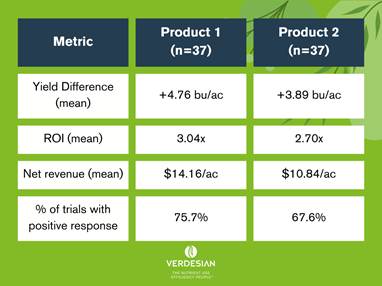
Figure 1: Average Performance of Product 1 and Product 2 Across 74 Corn Trials
If that is all you see, Product 1 wins on every line. Case closed, right? Actually, it depends.
Once we widen the frame and add contextual data like region and soil texture, the story starts to change:
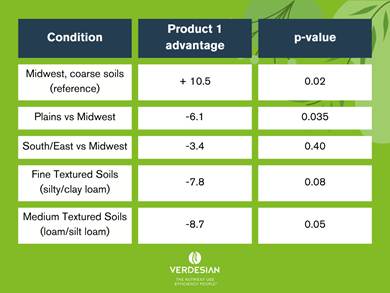
Figure 2: Product 1 Yield Advantage by Region and Soil Texture
In the Midwest, on coarser-textured soils, Product 1 pulled ahead by more than 10 bushels an acre. Move to the Plains, and that advantage fell by 6 bushels. Move to a medium- or fine-textured soil, and it fell another 7 to 9 bushels, in some cases disappearing altogether. Weather trended in the same direction, with drier conditions and lower drought stress appearing to favor Product 1. But once those trials were divided into smaller categories, there weren’t enough matched pairs in some groups to draw firm conclusions. That’s an important distinction, because something can be a trend worth watching without being a fact worth repeating at the coffee shop.
Before putting a result on repeat, figure out what made it a hit in the first place. The most important finding in the data was the simplest one: both products significantly out-yielded doing nothing. Everything beyond that, including which product was better and by how much, depended on where the frame was widened. The data isn’t lying to you; it just isn’t telling you the whole story until you widen the frame.
Same Song, Different Venue
That same idea applies once combines start rolling and stalks and stubble hit the ground. Residue breakdown starts the moment the combine passes, and how much of that residue is gone, or still standing guard over the soil, by next spring depends heavily on soil microbial activity. Bacteria and fungi do the actual work, but temperature, moisture, residue composition, and how much we physically help microbes get to that residue all influence what happens next.
Geography gives us one of the clearest examples of why context matters. Soil in the northern Corn Belt typically cools below roughly 50°F by late September or early October, while fields farther south may not hit that point until well into November or later. That creates a six- to eight-week head start or handicap on residue breakdown depending on which end of the map you’re on.
A residue-management strategy that makes sense in one geography, therefore, may not translate directly to another. Just as a product response in the Midwest doesn’t automatically tell you what will happen in the Plains, someone else’s residue timeline doesn’t automatically become yours. Same song, different venue.
The Field Sets the Tempo
Temperature is the metronome for microbial activity, and early fall warmth right behind harvest is when decomposition really gets moving. Soil microbes hit peak respiration somewhere in the mid-80s°F, and activity falls sharply on either side of that window. As soil temperatures slide below roughly 50°F, enzymatic activity throttles down and eventually stalls out for the winter. That’s why early fall matters so much. Every warm day right after harvest is a day of decomposition you don’t get back once the cold sets in.
Temperature isn’t playing solo, though. Moisture changes the tempo, too. Dry fall soils put the brakes on biological activity before it can get started, while saturated soils create anaerobic conditions that are far less efficient at breaking residue down. Microbial CO₂ respiration peaks near 70–80% of field capacity and declines under both dry and saturated conditions. Put temperature and moisture together, and the bigger point becomes clear: there isn’t one date on the calendar that tells you exactly what is happening below the surface. Conditions determine what can happen and when.
Not All Residue Plays by the Same Rules
Then there’s what you’re leaving behind. Not all residue breaks down at the same rate, and that has nothing to do with the weather. Soybean residue, with its lower carbon-to-nitrogen ratio, hands microbes plenty of nitrogen and disappears relatively quickly. Corn stalks and wheat straw are different stories. Their higher C:N ratio forces decomposers to scavenge nitrogen from the surrounding soil just to keep working, which slows the process. Add the lignin packed into the outer rind of a cornstalk, material that actively resists microbial attack, and you have residue that is built to stick around and protect the soil surface through winter, whether that’s what you wanted or not.
Management can speed or slow that process, but it doesn’t change the conditions microbes are working under. Mechanical sizing, whether that’s a chopping corn head or a pass of vertical tillage, increases the surface area microbes have to work with and gets more residue into direct soil contact, but it doesn’t decompose residue by itself. Extra nitrogen isn’t automatically the answer, either. Once soil temperatures cool into late fall, microbial response to additional nitrogen is limited no matter how much you apply because temperature is the gatekeeper, not fertility. So, how quickly will residue break down? Here we go again: it depends.
No One-Hit Wonders
Agriculture naturally pushes us toward simple answers. Which product won? What did the local trial show? When should I manage residue? What worked somewhere else? We want the one-hit wonder, the greatest hit, the thing that worked so we can put it on repeat—but soil texture, region, weather, temperature, moisture, residue composition, and timing can all change what a number or recommendation means. The goal isn’t to ignore trial data or recommendations. It’s to ask better questions about them and understand what was happening when a particular result occurred.
That same thinking should be carried over when deciding what products to use. Take AVAIL® T5, for example. The question isn’t simply whether phosphorus matters or whether a product can help improve phosphorus availability. The better question is whether that tool makes sense for the conditions in a particular field. Soil pH, soil-test phosphorus levels, and other field-specific factors all help determine placement. In other words, even a good song needs the right stage. Good agronomy isn’t about finding one “greatest hit” and putting it on repeat. It’s about understanding the conditions in front of you and choosing the right tool for each field.
Read the Room
As harvest wraps up, read the room, or in this case, the field. Look at what you’re leaving behind and when. Fields coming off early still have several weeks of warm soil left to work with, while fields finishing in late October or November may already be racing the thermometer. Look at the residue itself, too. Heavy, high-C residue like corn-on-corn stalks may need more help, more time, or both compared with a soybean field rotating out. The combination of what is in the field and the conditions surrounding it is what gives the management decision context.
The same thinking applies when trial results start rolling in. Look beyond the average and ask where the response happened, what soil it happened on, what the weather looked like, and what conditions surrounded that result. There is value in local data, but “local” by itself isn’t context. Don’t copy someone else’s setlist without knowing whether you’re playing the same venue.
One More Song
A wind of change means the conditions around us aren’t staying the same. And a good playlist changes depending on where, when, and for whom you’re playing it. Agronomy works the same way. A number, practice, or product doesn’t exist in isolation, and the conditions surrounding it are often what turn a simple answer into a useful one.
So, the next time somebody answers an agronomic question with “it depends,” don’t roll your eyes. Ask the next question: Depends on what? That’s usually where the useful part of the conversation starts.