

As soon as any fertilizer is applied to soil, it begins to interact with the environment. In many of those interactions, fertilizer nutrients can be permanently lost. Some nutrients are lost to the atmosphere as gases, some leach into ground water, while others adhere to soil particles. These losses mean applied nutrients aren’t available to plants. Around 50% of applied nitrogen and as much as 80% of applied phosphorus are not taken up by crops. Nutrient use efficiency aligns nutrient availability with plant needs and prevents loss to the environment as pollution.
Environmental Education Day is a reminder that understanding how nutrients behave in the soil—as well as how efficiently crops utilize them—can make a meaningful difference in crop performance. That’s where nutrient use efficiency, or NUE, comes into focus.
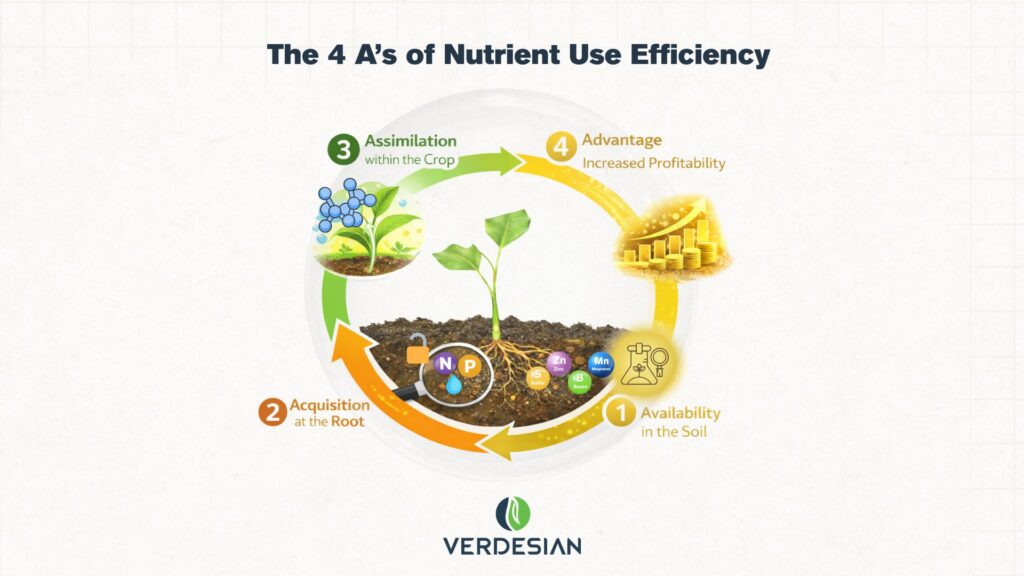
Nutrient use efficiency describes how effectively a crop accesses and uses the nutrients available to it. A simple way to think about NUE is through Verdesian’s 4 A’s, a framework that follows nutrients from the soil to yield and highlights the key steps that influence performance throughout the growing season.
Together, these four steps—availability in the soil, acquisition at the root, assimilation within the crop, and advantage through increased profitability—show how nutrients move from application to output.
- Availability in the Soil: It all starts with the soil, where nutrients must remain in a usable form long enough for crops to access them. Soil conditions, nutrient chemistry, weather, and biological activity all play a role in whether nutrients stay available or become tied up before plants can benefit.
- Acquisition at the Root: Even when nutrients are present, uptake depends on what’s happening at the root-soil interface. Root growth, soil structure, and microbial interactions all impact how efficiently nutrients move from the soil into the plant.
- Assimilation Within the Crop: Once nutrients are taken up, assimilation inside the plant drives how effectively they are put to work. Nutrients must be converted into proteins, carbohydrates, and other building blocks that support growth and development. Efficient assimilation helps crops use nutrients to stimulate stronger seedling establishment, improve resilience, and consistently perform through the growing season.
- Advantage Through Increased Profitability: When availability, acquisition, and assimilation work together, the advantage becomes clear. Crops are better positioned to make use of each applied nutrient, supporting improved input efficiency and advantage through increased grower profitability across the operation.
At Verdesian Life Sciences, nutrient use efficiency is about improving performance by helping growers get more from the nutrients already in their systems. When nutrients are used more efficiently, fewer are lost to the environment, supporting long-term soil and water health.
Nutrient use efficiency technologies are designed to support each of Verdesian’s 4 A’s: they help maintain nutrient availability in the soil, improve acquisition at the root, and support assimilation within the crop, so nutrients provide an advantage where they’re needed. When these steps function together, nutrients stay in the soil available to the plants and out of the environment, delivering a sustainable advantage through increased profitability, without sacrificing performance.